
BUILT AROUND HOW PEOPLE ACTUALLY THINK AND WORK
Your brain wasn't designed for the way most organisations ask you to work.
The world of work has changed. The systems running it haven't. Most organisations are still structuring work the same way they did decades ago and it's working against the way humans actually think and perform.
Design for Thinking fixes that. Built on neuroscience, psychology, and systems thinking to help organisations design ways of working that support better thinking and decision-making.
Why Design for Thinking exists
The world of work has changed. The systems running it haven't.
Most organisations are still designing workflows, structuring meetings, and managing people the same way they did decades ago. Meanwhile, the complexity has multiplied and the skills needed to navigate it have shifted completely.
People aren't struggling because they're not capable. They're struggling because the systems around them weren't built for the way humans actually function. Attention gets fragmented. Energy goes to the wrong things. Good thinking gets crowded out by busyness.
Design for Thinking fixes that. It's built around the skills that matter most right now — complex problem solving, clear decision-making, collaboration under pressure — and sets organisations up to handle whatever comes next.
Not just for today. For the fuuture
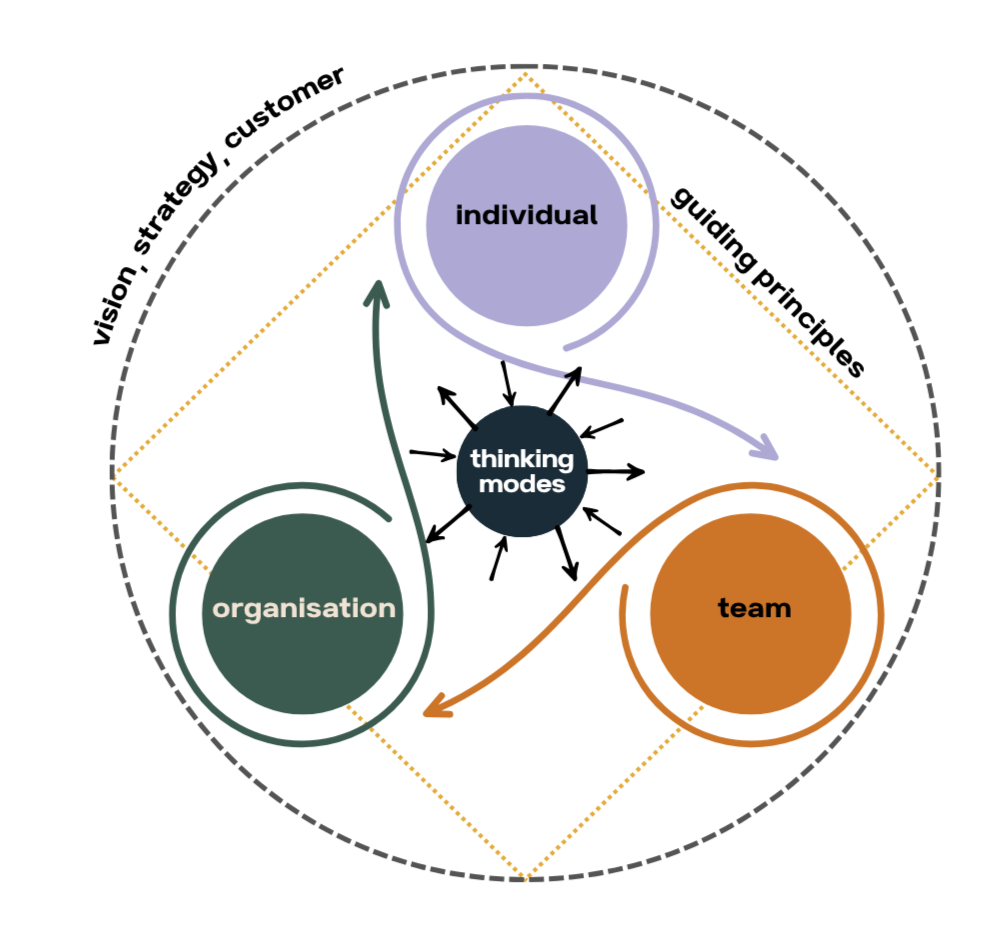
Four elements. One integrated methodology.
How it works in practice.
Seven Thinking Modes
Different work requires different types of thinking — analytical, creative, strategic, relational. Most organisations force constant context switching between all of them. DfT designs work that honours each mode so people can actually do their best thinking when it matters.

Three Thinking Zones
Individual focus time, collaborative thinking, and execution. Structured deliberately to protect deep work while enabling the coordination and connection teams need to move together.

Guiding Principles
Clarity beats complexity. Outcome over output. Leaders model the change. Simple rules that keep teams focused on what matters most rather than what's loudest.

The Collective Pulse
Operating rhythms that create predictable progress. Weekly check-ins, fortnightly decisions, quarterly resets. Momentum that compounds rather than resets every Monday morning.

Where Design for Thinking appliES
It works at every level of your organisation.
DfT isn't just for leadership teams or large transformation programs. It's a methodology that scales from individual leaders to entire organisations.
Individual leaders
For leaders who want to work more deliberately. Protect their thinking time, make better decisions, develop their people more effectively, and show up with more clarity and less chaos.
Teams and departments

For teams that are capable but losing too much to friction, noise, and unclear priorities. DfT redesigns how the team works together so collective performance follows.
Whole organisations

For organisations going through transformation, growth, or significant change. DfT provides the methodology that connects strategy to how work actually gets done across every level and function.
90% strategic alignment | +8pts employee engagement | 20% efficiency gains | 30+ organisations
Design work for the people doing it. And the future they're heading into.
Whether you're looking to embed DfT across your organisation, use it as the foundation for a leadership program, or just want to understand how it could work in your context, let's talk.