
Most organisations don't fail at strategy or execution.
They fail in the translation between the two.
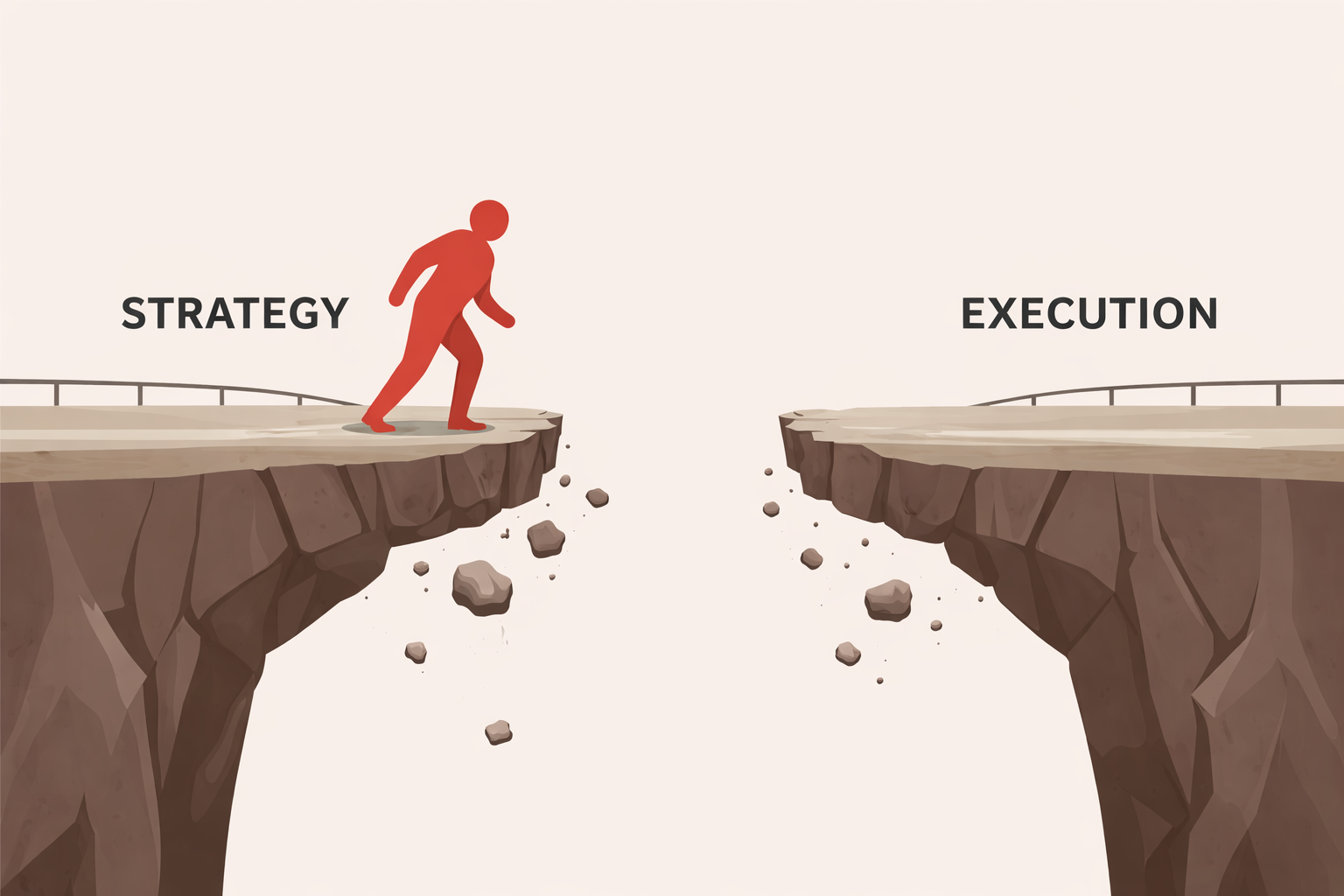
I've spent over a decade working in strategy and execution—often coming in after the big offsite has happened, the strategy deck is done, and planning's already underway.
And what I see, over and over, is this:
The strategy is solid. The team is capable. But somewhere between "here's where we're going" and "here's what we're doing about it," everything gets fuzzy.
That's where the damage happens. And it snowballs.
Small ambiguity at the start becomes months of rework, renegotiated priorities, and teams spending the rest of the year trying to "course correct" something that was never clear in the first place.
Strategy isn't the problem
Executive teams spend a lot of time on strategy—debating direction, looking at the market, thinking big picture.
The output usually sounds something like:
Grow market share
Be customer-led
Lead in digital
Lift efficiency
Build high-performing culture
These aren't bad strategies. They're often exactly right.
But they're strategic slogans—they sound good in the boardroom but don't mean much to anyone else yet.
After the offsite, executives typically move on to other priorities, assuming the hard work is done and the message is clear.
But this is actually when the next phase of work needs to happen—the translation phase. This is where leaders stay curious and help their teams answer questions like: What does "customer-led" actually mean for us? What are we prepared to trade off? What changes this year, and what stays the same?
These are often difficult questions to answer—but executives need to stay engaged and aligned through this process. They're accountable for the overall success of the enterprise, and this is where that accountability shows up in practice.
Without this step, teams are left guessing. And that's when clarity starts to unravel.
The jump that breaks everything
After strategy is "done," most organisations jump straight into execution:
Annual planning, OKRs, roadmaps, budgets, project portfolios.
Planning teams are suddenly expected to turn ambition into action—make trade-offs, define priorities, set measures, lock in commitments for the year.
All without the clarity they actually need to do it well.
So they guess.
They guess what matters most. They guess what "customer-led" really means. They guess what risk is acceptable. They guess what will keep executives happy.
And when people guess, they default to what they already know.
This is why so many organisations say they're transforming—but largely keep doing the same things with new labels.
The missing middle: strategy translation
This is where most organisations fall down.
Strategy translation is the work that happens between strategy and execution. Not an hour. Not a slide rewrite. Not a communication cascade.
Real work.
It's where strategy becomes decision-ready.
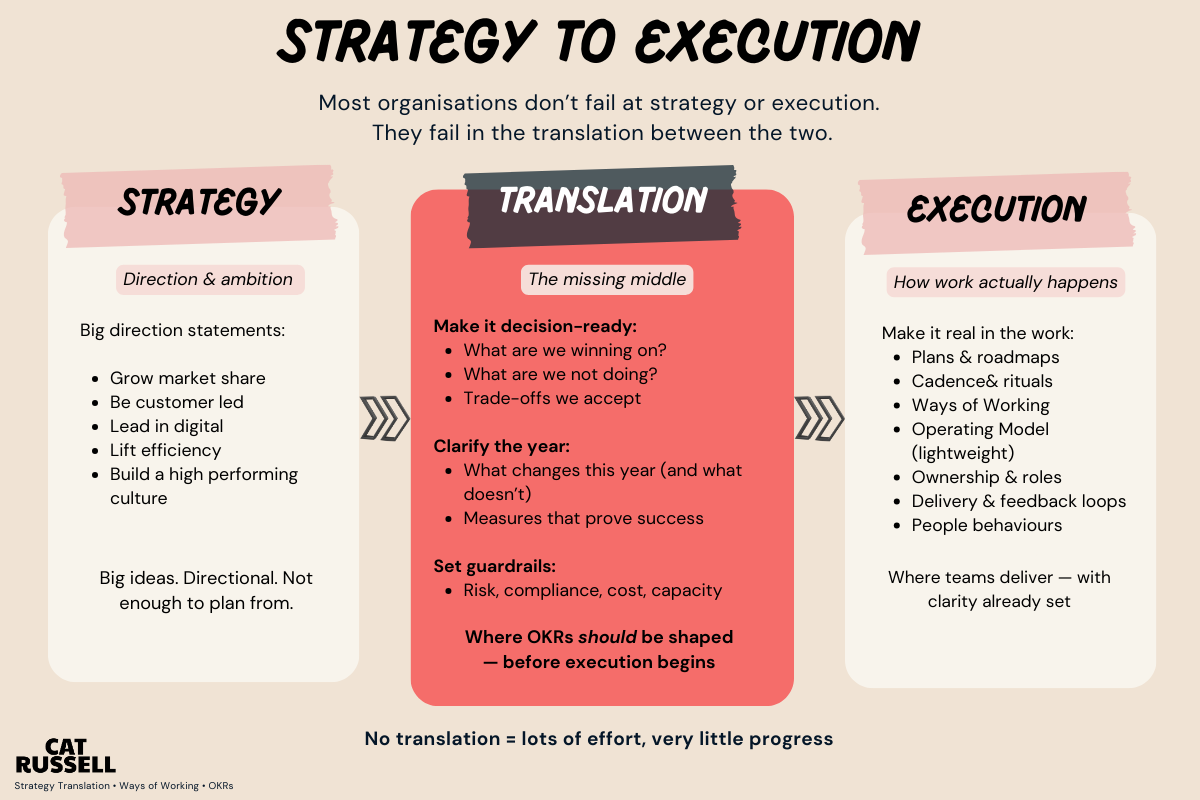
Strategy sets direction. Execution delivers results. Translation is the missing middle that makes both work.
This is the crucial work that shapes success for the year ahead. It's where OKRs should be shaped—not after execution begins, but right here in the translation phase. When teams skip this step and jump straight to setting goals, those goals end up vague or disconnected from what actually matters.
This is where leaders answer the hard questions that strategy decks rarely force:
What are we actually winning on this year?
What are we not doing—even if it hurts?
What trade-offs are we explicitly accepting?
What changes this year, and what deliberately does not?
How will we know if we're winning—beyond green status reports?
What are the real guardrails: risk, compliance, cost, capacity?
This is also where governance, finance, and risk belong—not bolted on later, but integrated into the thinking.
When this translation work is skipped, teams fill in the gaps themselves.
That's expensive. And exhausting.
Why this matters now
If you're about to head into planning—or you're already in it—this is worth pausing for.
When organisations invest properly in strategy translation:
Strategy flows cleanly up to boards
Teams understand not just what matters, but why
Planning time reduces (hallelujah!)
Decision-making speeds up
Delivery improves
People stop guessing and start focusing
This is why, in my experience, organisations often don't need massive overhauls or structural redesigns.
They need clarity.
And clarity starts here—in the missing middle.
If this resonates, let's talk.
I help organisations do this translation work properly—before roadmaps appear, budgets lock in, and teams spend another year rowing hard without moving in the right direction.
Sometimes the most valuable work is the pause that saves you a year.